The loop
Golden Path is built around five steps that take play to robots that work off-world. Each step below is marked honestly as working today, in progress, or planned, with a link to the proof where there is one.
- 01
Play → diverse human strategies
In progressDifferent players solve the same job in different ways: many shallow passes or one deep cut, scoop and dump or scrape and push. One scripted expert only ever shows one strategy, so this variety is the point.
Today. The game records every session at 10 Hz: pose, velocity, arm and bucket state, load, the terrain around the machine, task progress, the exact inputs and robot-camera frames. Each session is labelled with its controller, world, terrain source, control mode and lighting. Two tasks so far, on real NASA terrain of the Moon and Mars. Play a shift and download your session at the end.
Not yet. So far there are 15 recorded sessions, all from one player (the founder): a first test, not a dataset of diverse strategies. Next: sessions from many players, then opt-in upload so play pools into a shared dataset.
- 02
Imitation learning
Working todayDemonstrations bootstrap a policy: it learns to map what the machine observes to what the operator did.
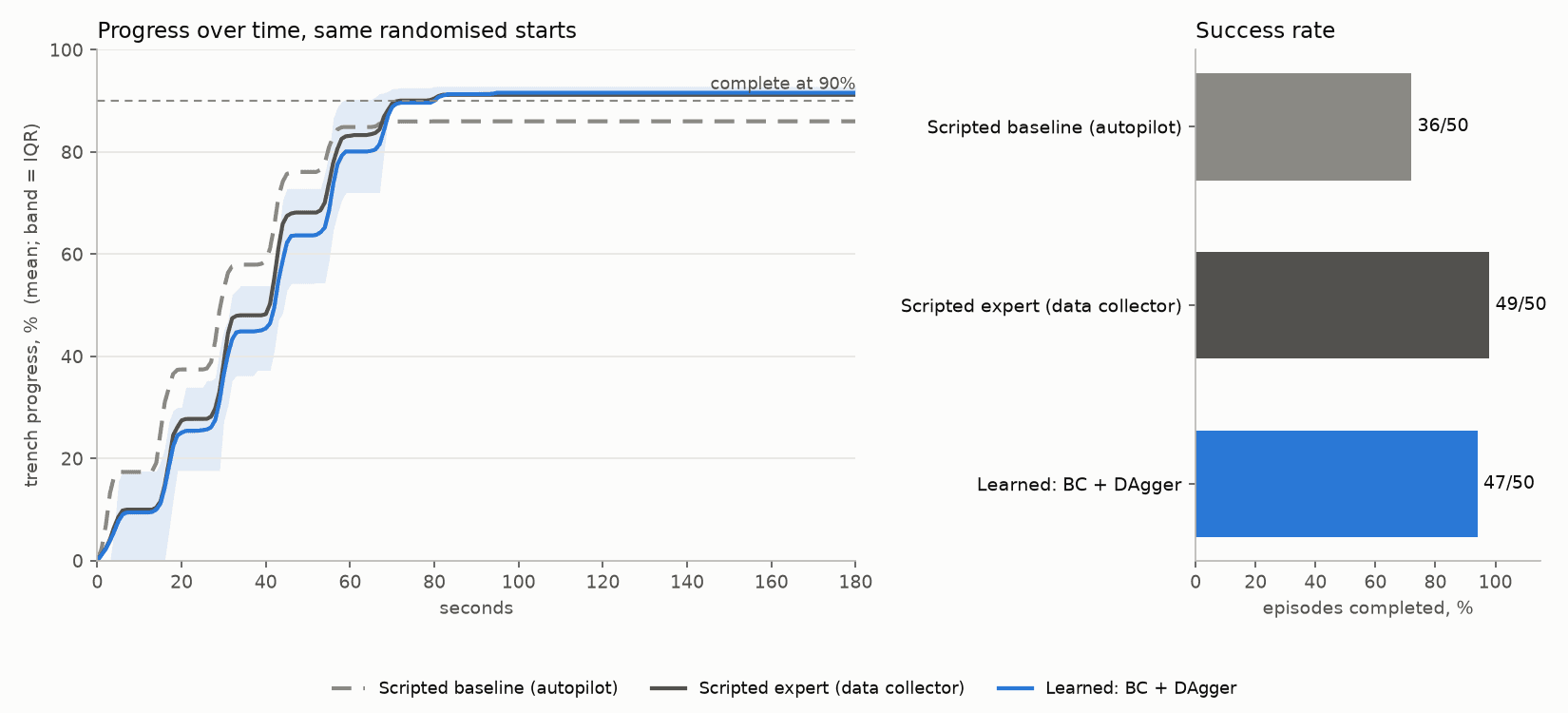
Today. A small neural network trained only on sessions the game logged digs the trench in 47 of 50 held-out random starts, using behaviour cloning plus DAgger, under the current physics (excavation forces, bucket-fill drag, a soil penetration limit, so the bucket has to crowd in rather than plunge, and wheels that sink and slip). Trained before the wheel model was added, the same policy scored 39 of 50 without it, and 48 of 50 under our earlier, easier physics. The scripted autopilot completes 36 of 50 from the same starts. Plain behaviour cloning alone completes 0 of 50. The policy runs in your browser: watch it dig. Sessions export to the Hugging Face LeRobot dataset format, so robotics teams can load them in their own tooling.
Not yet. The shipped policy is trained on scripted-expert data only, with no human play. First human tests, on 15 sessions from one player under the earlier physics: human-only behaviour cloning completed 0 of 50, and human plus scripted 9 of 50 (one training run each, not an established effect). The policy reads exact state, not camera images, and covers only the trench task.
- 03
Reinforcement learning at scale
PlannedHeadless batch simulation with rewards for progress, time and energy, and penalties for risk, refines a policy past its teachers. RL exploits physics errors, so simulation fidelity is a requirement, not polish.
Today. The pieces underneath exist. A headless batch runner already drives hundreds of evaluation and DAgger episodes. Every step logs the cutting force, power and cumulative energy from a published soil-mechanics model, which is what an energy term in a reward needs. The fidelity page lists what the simulation grounds in real data and what it still approximates.
Not yet. No RL training has been run yet. Next: reward shaping on top of the learned policy, with parallel headless rollouts.
- 04
Human mission plans → autonomy
In progressMars is 3–22 light-minutes away, too far to drive live, so people plan and the machine executes. Plans paired with their outcomes are training data for the planning layer.
Today. In supervised mode on Mars you place dig zones, dump zones and waypoints, then commit. The plan crosses the (time-compressed, labelled) signal delay, and the machine carries it out with an onboard executor. Every plan is logged as structured commands next to the step-by-step outcome. On the Moon, delayed teleop logs both the command the operator issued and the one the machine applied.
Not yet. The onboard executor is scripted, not learned, and no planner has been trained on plans yet. Next: collect plans, then blueprint-level tools for mission designers.
- 05
Sim-to-real
PlannedA cheap physical robot with an exact simulation twin runs the same trained policy in both worlds, which shows the data transfers to hardware.
Today. Nothing is built yet.
Not yet. Next: a low-cost arm with a scoop over a regolith-simulant sandbox (or a small excavator), its sim twin in Golden Path, and the same policy on both.
Imitation learning, measured
50 episodes per controller from the same randomised starts, none used in training, on the Moon (NASA LROC terrain, direct control). Success means the game's own completion: 90% of the trench dug to depth. Current physics (schema v5, with wheel–soil forces). The shipped policy (BC + DAgger) was trained on scripted-expert sessions only, and was chosen on separate validation starts before this evaluation was run. Measured on 2026-10-29.