Simulation fidelity
Training data is only as useful as you can trust it. Here is what in Golden Path comes from real measurements, what is approximated, and what we are building next. Every session file records its own sources (terrain product, location, gravity, lighting and signal delay), so each one can be traced back to them.
Grounded in real data
| In the game | Source | |
|---|---|---|
| Gravity | Moon 1.62 m/s² · Mars 3.71 m/s² | NASA NSSDCA fact sheets: Moon, Mars. Drives falls, hops, slope resistance and dust ballistics. |
| Moon terrain | LROC NAC DTM, 2.0 m/pixel, Connecting Ridge, 89.44° S 222.9° E | NAC_DTM_ESALL_CR1 (Scholten, DLR, for the ESA Lunar Lander project; archived by the LROC team, ASU). It is the finest public DTM we found inside one of NASA's Artemis III candidate regions. |
| Mars terrain | HiRISE DTM, 1.01 m/pixel, Jezero Crater at Perseverance's landing site, 18.4447° N 77.4508° E | DTEEC_045994_1985_046060_1985_U01 (HiRISE team, University of Arizona; NASA/JPL-Caltech/UArizona). |
| Signal delay | Moon 1.3 s one way (2.6 s round trip) · Mars 3–22 min one way, 12.5 min default | Light time: Earth–Moon mean distance, and Earth–Mars closest and farthest distances (54.6 and 401.3 million km), from the fact sheets above. |
| South-pole lighting | Sun 3° above the horizon, long hard shadows, almost no fill light | At the poles the Sun stays within about 1.5° of the mean horizon (spin axis tilted 1.54° to the ecliptic), and ridges see a lower local horizon. Mazarico et al. 2011, “Illumination conditions of the lunar polar regions using LOLA topography”, Icarus 211. |
| Excavation forces | Cutting, bucket-fill and penetration forces and traction under local gravity; per-step forces, power and energy logged | Cutting resistance from the fundamental equation of earthmoving (Reece 1964; McKyes 1985, Soil Cutting and Tillage), from soil density, cohesion, friction angle, cut depth and width, and gravity. Traction from Coulomb soil thrust, A·c + W·tan φ (Bekker; Wong, Theory of Ground Vehicles). Cohesion resists a cut as much on the Moon as on Earth, but traction falls with gravity, so on the Moon deep cuts hit the traction limit (Wilkinson & DeGennaro 2007, J. Terramechanics 44). The cutting angle is the bucket's real angle. Soil already in the bucket adds its weight × tan φ, which brings predicted forces within 0.76–1.19× of measured bucket tests (see Validation). Pushing the bucket straight down is resisted by the soil's bearing capacity (Terzaghi's equation, Vesić's factors) and limited by the force that would tip the machine, so in lunar regolith the bucket digs in by crowding forward along its floor, not by plunging. That penetration model is textbook, not yet validated against measurements. The HUD shows cut force against traction. |
| Lunar regolith | Density 1.50–1.74 g/cm³, cohesion 0.52–3.0 kPa, friction 42–54°, by depth | Carrier, Olhoeft & Mendell 1991, “Physical properties of the lunar surface”, Lunar Sourcebook ch. 9, Tables 9.4 and 9.12 (recommended values for intercrater areas). Soil gets denser and stronger as a trench deepens. |
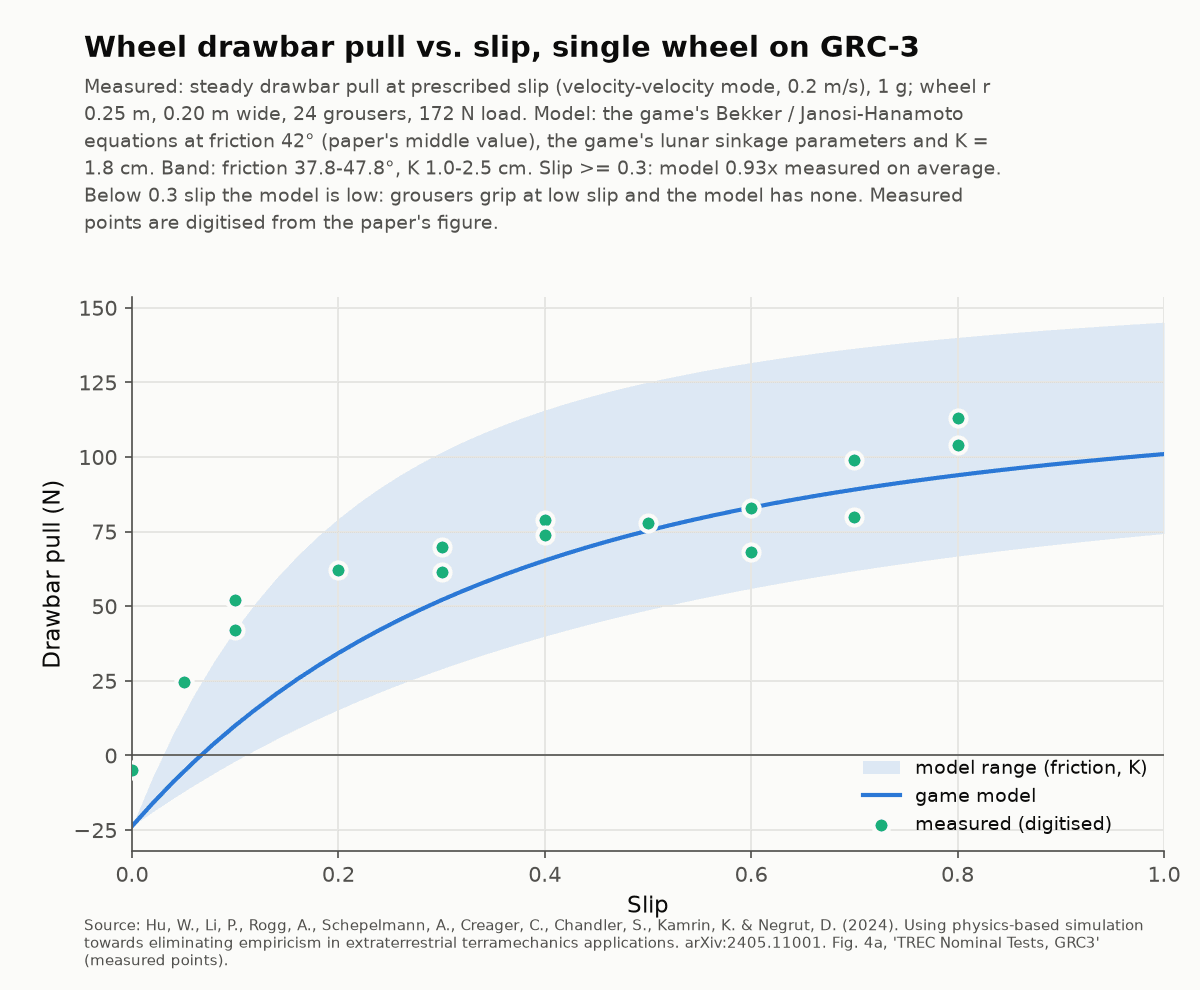
| Wheels on soil | Sinkage, slip-dependent thrust and rolling resistance per wheel, under local gravity | Bekker's pressure–sinkage for a rigid wheel and the compaction resistance of its rut, with Janosi–Hanamoto shear for thrust that grows with slip (Bekker 1969; Janosi & Hanamoto 1961; Wong, Theory of Ground Vehicles). Each wheel's load comes from the machine and its bucket load. On the Moon the 20 t machine sinks about 10 cm and its usable pull drops by about 40%. Against a NASA Glenn single-wheel test on lunar simulant GRC-3, the model gives 0.93× the measured drawbar pull at 30% slip and above, and runs low at small slip (see Validation). The lunar soil values are the commonly cited Apollo-era ones; the Mars values are approximated. ?wheels=coulomb switches back to the simple traction limit. |
Approximated
These are deliberate shortcuts to get a playable, deterministic simulation running in any browser. They bound what the data can be used for today: it teaches task structure and operator strategy, but not contact dynamics.
| Today | What that means | |
|---|---|---|
| Soil mechanics | Forces are physics; soil flow is not | Cutting forces and traction limit the machine, but the soil itself still moves kinematically: the bucket edits the heightmap and volume is conserved. There is no granular soil model. 3-D side wedges, inertial cutting terms, breakout forces, grousers and slip-dependent sinkage are not modelled. The machine (20 t, 8 kW drive, 8 kW hydraulics) is a design assumption, far heavier than a real lunar excavator would be. |
| Mars regolith | Representative values | Friction 35°, cohesion 1 kPa, density 1300 kg/m³, from Viking (Moore et al. 1987, USGS PP 1389), MER wheel trenches (Sullivan et al. 2011, JGR 116) and InSight pre-landing estimates (Morgan et al. 2018). Nobody has measured soil strength in situ at Jezero, and the game uses one layer for all depths. |
| The machine | Design assumptions | 20 t (the class of a terrestrial loader with a 3–4 m³ bucket), 8 kW of drive power while cutting, 0.6 m² of tyre contact, 45° effective rake, soil–tool friction 0.5 φ. An onboard anti-stall lifts the boom while the wheels slip, like the auto-dig on wheel loaders. A real lunar machine would be lighter and even more traction-limited. |
| Vehicle | Kinematic, force-limited while cutting | The chassis rides the heightmap on four wheel samples, at its wheels' sinkage. Wheel–soil forces limit acceleration, cutting and climbing; turning is kinematic, and there is no suspension or arm dynamics. Gravity enters through slopes, falls, hops, wheel loads and traction. |
| Terrain below the DTM resolution | Interpolated + procedural | Bicubic upsampling to the 0.5 m game grid, plus procedural roughness (3–3.5 cm RMS) and small craters on the Moon. Every session header records the exact parameters and seed. This detail is not real topography. |
| Sensors | Perfect | Logged pose, velocity and terrain heights are ground truth. The 192×108 robot camera has no noise, blur, rolling shutter or exposure limits. |
| Light and sky | Art-directed | The sun azimuth is fixed rather than taken from an ephemeris, and its disk is drawn about 3× true size so it reads on video. Mars sky colour, haze and dust drag are visual approximations. |
| Sound | Synthesized, art-directed | Drive motors, cutting, dumping, hydraulics and wheel slip are generated in the game and follow the machine's live state. There is no air on the Moon to carry sound, so on the Moon it stands in for what an operator would feel through the machine. Press M to mute. |
| Communications | Light time only | No Deep Space Network scheduling, bandwidth limits or packet loss. Supervised-mode waits on Mars are time-compressed 60× and labelled that way in the game and in the data. |
| Autonomy baseline | Scripted, uses ground truth | The plan executor and the trench autopilot read the true terrain state. There is no perception stack. They are baselines to beat, not claims about flight software. The learned trench policy (?policy=1) is trained on scripted-expert sessions logged by the game (behaviour cloning + DAgger), reads the same ground-truth state, and so far covers only the Moon trench task. |
Validation
We ran the game's force equations, unchanged, on 21 published NASA Glenn soil-bin tests with buckets in lunar simulants, using each test's own tool, depth, rake angle and soil. The cutting-edge force on its own under-predicts every test (a median 0.21× measured). The game now adds the drag of the soil held in the bucket, its weight × tan φ, with no fitted constant. On the 5 tests whose papers report enough to compute the bucket's fill, predictions are a median 1.12× measured (0.76–1.19×, mean absolute error 17%). For the other 16 the fill can only be bounded between an empty and a full bucket; all 16 measurements fall inside that wide range. The tests are small (25–70 cm tools, 3–10 cm cuts) and at Earth gravity, so this checks the equations, not the game's scale or the Moon's gravity.
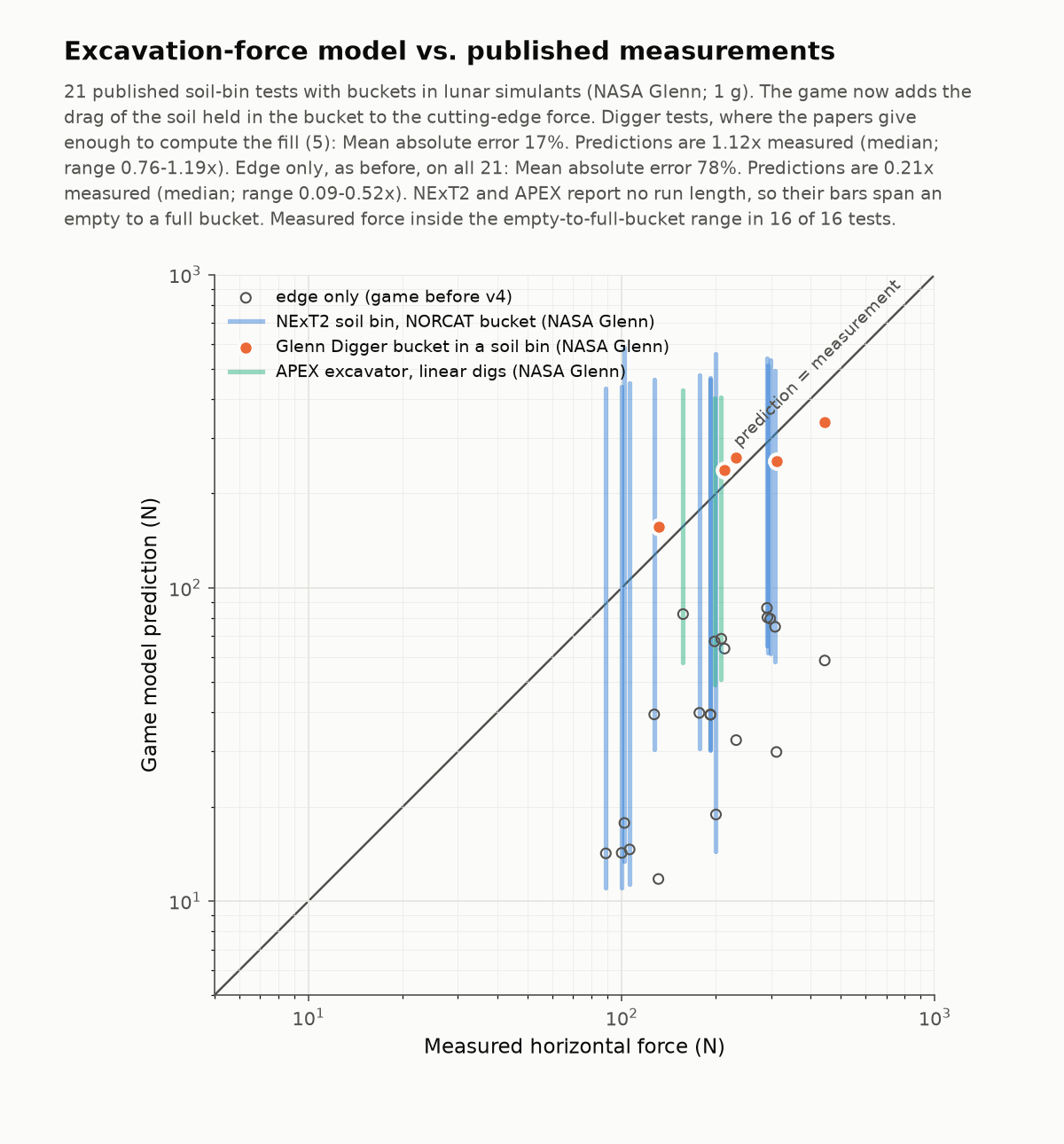
Data: Gallo, Agui, Creager & Oravec 2012, AIAA Aerospace Sciences Meeting (NTRS 20120002750, 13 tests); Johnson et al. 2012, ASCE Earth & Space (NTRS 20140017060, 5 tests); Proctor et al. 2021, ASCE Earth & Space (doi:10.1061/9780784483374.020, 3 conditions). Every measured value is taken from the papers' tables. The full analysis, per-dataset charts and code are in the game repo's VALIDATION.md, with a parity test showing the Python reproduction matches the game's code exactly.
Wheels: drawbar pull vs. slip
The wheel model, run at a NASA Glenn single-wheel test's own wheel size, load and soil friction on lunar simulant GRC-3, gives 0.93× the measured drawbar pull on average at 30% slip and above (mean absolute error 10.5 N on a 172 N load). Below 30% slip it is about 30 N low: the test wheel has grousers, the model has none. The measured points are read off the paper's figure, not a table, and the paper gives no sinkage parameters for this simulant, so the model uses the game's lunar values. Data: Hu et al. 2024 (arXiv:2405.11001), NASA Glenn TREC rig, at Earth gravity.
Roadmap
| Goal | Plan | |
|---|---|---|
| Penetration and gravity checks | Validate the rest of the dig | Check the bucket-penetration model against measured vertical insertion forces, and check how forces scale with gravity using reduced-gravity test data or the high-fidelity offline twin. Every test we validate against so far is at Earth gravity. |
| Granular soil | Soil that flows | 3-D blade forces, granular soil flow and slip-dependent sinkage, cross-checked offline in a high-fidelity granular simulator (Project Chrono) and against more single-wheel and reduced-gravity test data. |
| Sensor realism | Noise, latency, bandwidth | Camera noise and exposure under polar lighting, IMU and odometry drift, and downlink bandwidth caps that limit frame rate and resolution in delayed modes. |
| Domain randomisation | Many sites, many conditions | More DTM crops across the Artemis candidate regions and Mars landing sites, sun angle from ephemerides, randomised soil parameters, delays and machine wear. |
| More machines | Beyond one excavator | Bucket-wheel excavator, bulldozer blade, regolith hauler, and drill. All would share the same logging schema and controller interface. |
Try the modes
Moon, direct control · Moon, 2.6 s round-trip teleop · Mars, supervised autonomy · Level a landing pad · Learned policy digs the trench